
I want to explain the risks that I am aware of. This will make for a long read. Please read all the information on this page, do additional research and due diligence, and make your own decision on what to do with this information.
This page is purely for educational purposes. I want to try and tell you all the complicated things, especially the risks, I have learned since I started researching forex bots. Even with giving this information, nothing here should be taken as advice or an encouragement to use forex bots. Forex bots are a very high-risk form of gambling. The offshore brokers are also another risk factor.
The finance bots have been very good for me, but I want to be very clear and say the forex bots should still be considered as a form of gambling and you could lose 100% of your betting bank, they are not investing, even though the buttons on the offshore broker websites say “Invest”.
As a gambling system, the bots I am using have been much smoother and better than my own BSG betting bots.

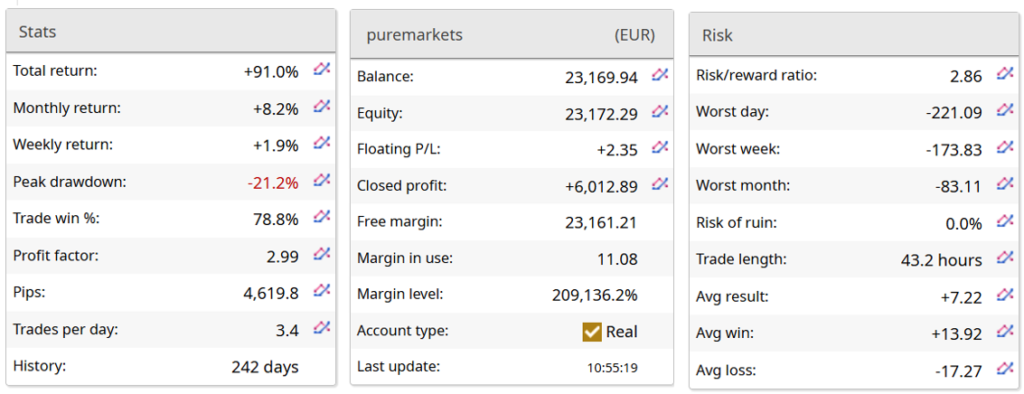
The above screenshot is taken from a 3rd party verification and tracking website that gets the live trade data of the bots.
https://www.fxblue.com/users/puremarkets
I use this to get a good indication of the performance of these bots.
The same trade data is also sent to this 3rd party verification and tracking website.
https://www.myfxbook.com/members/martin1024/mh-trading-pamm-surgeonfish/12024508
It is important to be aware of the risks of forex bots.
The two main risks are the bots themselves and the brokers (both domestic and offshore ones).
I will explain what I think the risks are and how I have done my due diligence to satisfy myself that my gamble is a smart one, and not a scam or fraud or getting taken advantage of.
First, I want to go through some key concepts in forex bots and brokers that were unfamiliar to a sports bettor like me.
Key Concepts 1: Market Maker vs STP brokers
Key Concepts 2: Leverage
Key Concepts 3: Offshore brokers
Key Concepts 4: Negative Balance Protection (NBP)
Key Concepts 5: PAMM account
Key Concepts 6: Most Forex traders lose their money
Key Concepts 7: Extreme Market Event Risk
Key Concepts 8: Even brokers in highly regulated regions cheat customers.
Key Concepts 9: How do brokers make their money?
Key Concepts 10: Actual forex bot and broker scams
Key Concepts 11: Illegal broker behaviour
Key Concepts 12: The Risks of Offshore Brokers
Key Concepts 1: Market Maker vs STP brokers
Key Concepts 1: Market Maker vs STP brokers
The two primary execution models for financial brokers are Market Makers (also known as Dealing Desk brokers) and STP (Straight-Through Processing) brokers.
These two models dictate how your orders are routed, the spreads you pay, and how the broker makes money.
1. Market Maker
A Market Maker literally “makes” or creates the market for the asset you are trading. Instead of sending your order to an external exchange, they take the opposite side of your trade in-house.
- How it works: When you click “buy,” the broker buys from you; when you sell, they buy from you. They operate in a closed environment using a dealing desk.
- How they make money: Instead of commissions, they usually profit from a fixed spread (the difference between the buy and sell price).
- Pros: Often offers fixed spreads, instant execution, and typically no slippage (getting filled at a different price than intended).
- Cons: There can be an inherent conflict of interest, as your loss can be their direct profit, and they have the ability to re-quote prices during volatile markets.
2. STP (Straight-Through Processing)
An STP broker acts purely as an intermediary (or agent) between you and the broader financial markets, such as major banks and liquidity providers.
- How it works: Your order bypasses the dealing desk entirely. The broker routes your trade directly to their external liquidity providers, who then fill the order at the best available market price.
- How they make money: They usually add a small markup to the variable spread you receive from the liquidity providers, or they may charge a flat commission per trade.
- Pros: Highly transparent execution with no dealing desk intervention. Because trades are routed straight to the market, there is generally no conflict of interest.
- Cons: Spreads are variable, meaning they can widen significantly during news events or high volatility, and costs can change depending on market conditions.
In sports betting terms, I would compare a Market Maker to a sportsbook with worse odds than betting exchanges. They win when you lose. And they win long term because their prices are worse than the fair value of the bet at that moment. And I would compare a STP broker to inplay markets on a betting exchange. They make money from commission on trades. They don’t care if you win or lose. But it is better for them if you win because you stay betting longer. The odds for inplay markets can move fast and if an extreme market event happens, the odds can move quickly in one direction.
Key Concepts 2: Leverage
In trading, leverage means using borrowed funds from a broker to control a much larger position than your actual capital allows. It amplifies your market exposure, meaning both your potential profits and potential losses are significantly magnified.
How Leverage Works
To open a leveraged trade, you don’t need the full value of the asset; you only put down a small upfront deposit called margin. The rest is covered by your broker.
- The Ratio: Leverage is usually expressed as a ratio (e.g., 10:1, 20:1, or 100:1. A 10:1 leverage means for every $1 of your own money, you can control $10 worth of an asset.
- The Math: If you want to buy $1,000 worth of stock with 10:1 leverage, you only need to put down $100 in margin. If the stock goes up by 10%, you make $100 instead of just $10 (a 100% return on your actual investment). However, if the stock drops 10%, you lose your entire $100 deposit.
The Pros and Cons
- Pros: Magnifies returns on successful trades, allows you to enter larger markets with less starting capital, and lets you diversify your portfolio more easily.
- Cons: Your losses are calculated on the full size of the position, not just your margin. This means you can lose more than your initial deposit if you do not have proper risk management.
Managing the Risks
Because leverage is a double-edged sword, successful traders rely heavily on risk management:
- Use Stop-Losses: Always set an automatic exit point to limit your downside on losing trades.
- Start Small: Beginners are generally advised to use very low leverage (e.g., 2:1 to 5:1 until they understand the mechanics and volatility of the market.
- Regulated Limits: If you are a retail trader in the UK or EU, regulators cap the leverage brokers can offer you to protect you from severe debt (ranging from 30:1 for major forex pairs to 2:1 for cryptocurrencies.
- Offshore brokers: Brokers based outside heavily regulated regions like the EU, the UK, US, Australia and Japan are often called offshore brokers and offer higher margins of 1:200 or even 1:500. These margin levels are considered very high and extremely risky for novice traders. Well-known offshore broker locations are Vanuatu, St. Vincent and the Grenadines (SVG), Seychelles, Mauritius and the Cayman Islands
To read another explanation of leverage trading you can view CMC Markets Trading Terms.
In sports betting terms, if I had $1,000 and was using leverage of 1:100, then I could place bets as if I had $100,000, and I can keep all the profit, but if my “cash out now” figure ever drops to -$1,000 of my actual personal funds, then the bet would be cashed out automatically and I would have nothing left. For example, If Barcelona is winning 2-0 and their odds are 1.10, then I would love to bet $100,000 on that and hope to win $10,000. With time ticking away, I expect the odds to slowly drift down to 1.01. But if the other team scores to make it 1-2, and the odds jump to 1.50. Then my bet would be cashed out and I lose all of my $1,000. Leverage can be dangerous if not used carefully.
I have asked Martin about how his bots are setup to avoid the big losses that can come with high-leverage. He said that he takes several steps to reduce the risk on his bots.
1. He avoids holding highly leveraged positions over the weekend.
2. He sets a hard maximum exposure per symbol/group.
3. He avoids using excessive notional exposure on accounts with low equity.
4. He avoids events with gap-risk potential.
5. He keeps a margin buffer well above the stop-out level.
Martin also said “My bot setup is quite conservative and usually holds a really big margin reserve, so I would say they keep to the above safety points. Also, my account has already survived several shock events already such as Trump’s tariffs, surprising mid-weekend geopolitical announcements and other sudden market environment changes. And at those times it was with riskier bots that I am no longer using in our current set. But even having said that, it is important to clearly state that people may lose their entire deposit.”
Key Concepts 3: Offshore brokers
Offshore brokers are used by traders seeking higher leverage, lower tax liabilities, and relaxed entry rules. The most famous and widely utilized offshore jurisdictions for these brokers include:
- St. Vincent and the Grenadines (SVG): The most popular choice for startups and modern brokers due to minimal setup costs, fast licensing, and no specific leverage caps.
- Seychelles: A recognized offshore hub overseen by the Financial Services Authority (FSA), allowing high leverage (often up to 1:500 and offering a solid balance between flexibility and regulatory oversight.
- Mauritius: A well-regulated jurisdiction that appeals to larger brokerage firms, offering an ideal environment with favorable corporate tax rates.
- Vanuatu: Known for licensing virtual-asset service providers and dealers quickly, while permitting traders to access aggressive leverage ratios.
- Cayman Islands: The premium tier of offshore jurisdictions. It boasts sophisticated legal and banking infrastructure favored by serious traders and institutional funds.
While these jurisdictions provide advantages like relaxed restrictions on Forex and CFDs, they typically offer lower levels of investor protection compared to stricter, onshore regimes.
(Source: Google)
Choice of Three Offshore Brokers Available
We now have three offshore brokers available that are all running the same bots with the same settings. Each broker is using the same trading software, but they will still have variations in their results due to how each company runs their trading servers. This is another reason where it makes sense to spread risk by using multiple brokers where possible.
| Broker | Started / Jurisdiction | 3rd Party Verification & Monitoring Site | Average Monthly Profit / Total Profit | Restricted countries |
| Pure Markets | 2025-10-1 Vanuatu | FXBlue MyFXbook | +8.5% ave. per month +110% in 10 months | USA |
| Radex Markets | 2026-6-23 Seychelles | FXBlue MyFXbook | +8% ave. per month +8% in 2 weeks | USA, Australia, Malaysia |
| Vantage Markets | 2024-9-9 Vanuatu | FXBlue MyFXbook | +7% ave. per month +367% in 23 months | USA, UK, Australia, Canada, Japan, China |
Data: 2026-7-7
I use Pure Market (Vanuatu) and Radex Market (Seychelles).
Martin uses Pure Market (Vanuatu) and Vantage Markets (Vanuatu).
I am happy with Pure Market and Radex Markets customer service so far, and it seems logical to spread risk by splitting future deposits between two brokers in two different jurisdictions.
To compare it to sports betting again, even if I started with $1,000-$5,000, I would not want to build up a balance of $100,000 in one betting agent like BetInAsia. I would prefer to split it among two betting agents, such as $50,000 in PremiumTradings and $50,000 in BetInAsia. Even though I have never had problems with either company, it just makes sense to spread risk when balances get larger.
Key Concepts 4: Negative Balance Protection (NBP)
Negative balance protection is a risk management safeguard provided by brokers that ensures your account balance cannot drop below zero. If sudden market volatility causes severe losses, your broker absorbs the excess deficit and resets your balance to zero, preventing you from owing them money.
How it works
When trading on margin with leveraged products (like CFDs or Forex), a fast-moving market can sometimes trigger massive losses that exceed the total funds you deposited before the broker has a chance to close your positions.
- Without Protection: You would owe the broker the difference, putting you in debt.
- With Protection: The broker writes off the negative amount. Your account balance is simply reset to zero, and your losses are capped at your initial deposit.
Why it is important
- Prevents Debt: It gives you peace of mind that a single flash crash or market gap will not leave you bankrupt or owing thousands of dollars/pounds to your broker.
- Regulatory Mandate: In many jurisdictions, such as the UK and the European Union, financial authorities legally require brokers to provide negative balance protection for retail traders.
- Not a Substitute for Risk Management: While it limits your maximum loss, it does not prevent you from losing your entire deposit. It is still highly recommended to employ proper risk management tools like stop-losses and smart position sizing.
Important Caveats to Consider:
- Account Status: Be aware that NBP typically only applies to retail client accounts. If you register as a professional trader, this protection is often waived.
- Extreme Market Gaps: In highly volatile markets or over severe weekend gaps, automated stop-out systems and NBP can sometimes experience slippage before trades are liquidated.
- Regulatory Oversight: Pure Market operates as an offshore broker under the Vanuatu Financial Services Commission (VFSC). Unlike brokers regulated by the UK’s Financial Conduct Authority (FCA), tier-3 offshore jurisdictions may lack the same strict enforcement of investor protections.
- Abuse of Negative Balance Protection: Be aware that some brokers may revoke Negative Balance Protection if they review an account and determine that a user purposely set up their trading system to take advantage of the Negative Balance Protection by taking deliberately risky positions planning on the fact that the broker will absorb their losses.
My chosen brokers, Pure Market and Radex Markets, have Negative Balance Protection (NBP) for its clients. This safeguard ensures my trading losses cannot exceed the funds I deposited, meaning I should not incur personal debt or owe the broker money if my account drops below zero.
I have asked my account agents for both and confirmed it with both.
For any questions regarding how NBP is applied to your specific account, contact Pure Market directly or review their policies via the Pure Market FAQ.
Key Concepts 5: PAMM account
A PAMM account is basically an account that lets you copy another person’s trades. This is similar to automated sports betting using another person’s bots when you don’t know what the bot settings are. But it is not as simple as sports betting bots, since there are a lot of other new risks to learn about when using a PAMM account.
A PAMM (Percentage Allocation Management Module) account is an investment mechanism that allows investors to pool their money and have a professional trader (the money manager) trade on their behalf. You earn passively based on the manager’s success, but you also share in the losses proportionally.
The system operates simply and transparently:
- No Direct Access: You do not send your money to the trader’s personal account. Your capital stays in your own broker account, and the trader only receives permission to execute trades using a designated portion of your funds.
- Proportional Shares: All funds in the pool are managed collectively. If you contribute 10% of the total pool, you get 10% of the trade volume, profits, and losses.
- Fees: The money manager does not work for free. They typically take a pre-agreed performance fee (e.g., 30%) from the profits they generate for you.
- Transparency: Depending on the broker, you can monitor the account’s performance, open positions, and trading history in real-time.
Key Advantages
- Automated: Ideal for individuals who want to be active in financial markets (like forex) but lack the time, experience, or desire to actively trade.
- Aligned Incentives: Because the manager typically shares in the pool with their own capital and earns a fee on net profits, their interests are highly aligned with yours.
Things to Keep in Mind
- Market Risk: Past performance does not guarantee future results. If the manager makes bad trades or has weaknesses in his bot settings, you will lose a proportional percentage of your investment.
- Broker Reliability: Because these are handled through specialized brokers, it is vital to research and choose a platform with strict regulatory oversight and a strong reputation.
PAMM accounts are basically like automated tipster accounts in sports betting. We connect our betting account, and remain in control of our money that we can withdraw anytime, and the tipster bets for us. We don’t really know what they are doing and just hope that their historical performance continues.
Key Concepts 6: Most Forex traders lose their money
80% of retail forex trader accounts lose money. (“The UK’s Financial Conduct Authority (FCA) consistently reports around 80% of accounts unprofitable,”) Those numbers sound like gambling numbers! Most gamblers lose money, too. Just because they are financial markets, and not sports betting markets, it does not make it any easier or more likely to find a winning system. PAMM accounts where you can copy someone’s trades is similar to following a tipster in betting. Often, we have no idea what the bot is doing. So it is important to know as much as you can about that tipster (PAMM account manager) and be realistic about the risks.
“Global regulatory bodies have consistently documented poor outcomes for retail participants. The European Securities and Markets Authority (ESMA) found that between 74% and 89% of retail CFD accounts lose money, with average losses ranging from €1,600 to €29,000 per client over the reporting period. The UK’s Financial Conduct Authority (FCA) estimates roughly 80% of UK-based CFD traders are unprofitable, and cites the “structural asymmetry” of the business model as a driver of these results. The FCA has stated that its product intervention measures — including leverage caps, margin close-out rules, and the prohibition of monetary inducements — have prevented an estimated £100 million in annual retail losses.” Source: “The Wolf Packs of Retail FX: How a decade of offshore platforms, boiler rooms, and “legal” leverage reshaped a gray trillion-dollar trade” 20 min read, Aug 12, 2025 https://medium.com/@GlobalTimesSingapore/the-wolf-packs-of-retail-fx-a52f19388c5b
In my case, I know my PAMM manager. He is not a mystery tipster on the internet. Martinis a Betaminic veteran who I have known for over 3 years since Jan 2023. We have communicated about various methods and techniques for using statistics to find profitable patterns while avoiding backtesting pitfalls such as overfitting and survivor bias. From my communications with him, I have found Martin to be a very intelligent, polite and analytical person with a good level of stability, calm and understanding even when facing large downturns such as the MDDE set experienced at the end of 2025. In early 2026, Martin shared another passion of his, which is financial trading bots. In his case, he has Forex and Metals trading bots that have made an average profit of +8% per month over 9 months since October 1st 2025 using high-risk leveraged trading. That is 9 months of actual trading results with his own real money (and some of his friends and family, too.). A +90% increase on the betting bank in 9 months. He also has similar bots running on another broker for 22 months that have made +252%. I begged him to let me try it, and after explaining the risks, he finally let me. So I have not found some random tipster on an internet site whose main aim was to make money from others, but these were his bots for himself, and then later for his friends and family. And now after 22 months with a worst drawdown of -27%, he is letting me use them, and also opening up to people who follow my BSG betting diary and newsletter. So I am happy that I have done my due diligence on my PAMM manager.
At the moment, Martin runs his forex bots on three trading platforms. Pure Markets, Radex Markets and Vantage Markets.
Their trading platforms run similar bot sets. He ran some more risky bots near the start, but on Pure Markets, since more people have started following, Martin has cut out the riskier bots and is just using the ones he feels are comparatively more conservative. This is why you can see differences in the performance levels.
He has connected those trading platforms to two monitoring sites to track performance, FXBlue and MyFXbook.
Martin is offering access to his bots on all three brokers.
| Broker | Started / Jurisdiction | 3rd Party Verification & Monitoring Site | Average Monthly Profit / Total Profit | Restricted countries |
| Pure Markets | 2025-10-1 Vanuatu | FXBlue MyFXbook | +8.5% ave. per month +110% in 10 months | USA |
| Radex Markets | 2026-6-23 Seychelles | FXBlue MyFXbook | +8% ave. per month +8% in 2 weeks | USA, Australia, Malaysia |
| Vantage Markets | 2024-9-9 Vanuatu | FXBlue MyFXbook | +7% ave. per month +367% in 23 months | USA, UK, Australia, Canada, Japan, China |
The three brokers (Pure Market, Radex Markets and Vantage Markets) have almost the same bots, but each trading platform has slight differences in how they activate and process their trades based on the bot instructions. (The same goes for different kinds of automated betting software.) This can lead to slight differences in the performance of the trading platforms as shown in the monthly results below.
| Broker | Started / Jurisdiction | 3rd Party Verification & Monitoring Site | Average Monthly Profit / Total Profit | Restricted countries |
| Pure Markets | 2025-10-1 Vanuatu | FXBlue MyFXbook | +8.5% ave. per month +110% in 10 months | USA |

| Broker | Started / Jurisdiction | 3rd Party Verification & Monitoring Site | Average Monthly Profit / Total Profit | Restricted countries |
| Radex Markets | 2026-6-23 Seychelles | FXBlue MyFXbook | +8% ave. per month +8% in 2 weeks | USA, Australia, Malaysia |

| Broker | Started / Jurisdiction | 3rd Party Verification & Monitoring Site | Average Monthly Profit / Total Profit | Restricted countries |
| Vantage Markets | 2024-9-9 Vanuatu | FXBlue MyFXbook | +7% ave. per month +367% in 23 months | USA, UK, Australia, Canada, Japan, China |

As a gambler, I look at these results, and I feel comfortable to risk a betting bank on Martin’s bots. I think his methods and ideas are working.
Key Concepts 7: Extreme Market Event Risk
Some forex trading accounts can look very good for a long period of time.
But the “fragility of the system became clear in moments of extreme market stress. The most dramatic example was the Swiss National Bank’s decision on January 15, 2015 to abandon its 1.20 floor against the euro — a policy that had been in place since 2011. The sudden, uncontrolled appreciation of the Swiss franc by as much as 30% in minutes caused catastrophic slippage across retail platforms. Many client stop-loss orders could not be filled at expected prices, leaving accounts deeply negative and creating instant multi-million-dollar exposures for brokers. Alpari UK, a prominent FCA-regulated brand, entered insolvency within 24 hours. FXCM absorbed a $225 million loss and was forced into a bailout by Leucadia National (now Jefferies Financial Group)”. Source Link
This kind of extreme market event is not really something we can see in sports betting. For those people who follow my betting diary, you may remember how in December 2025 myself and a few other people reported that most of their bots suddenly started making enormous losses across multiple sports (football, horse racing, greyhounds), losing -100% of banks in some cases. It was as if a major shift in the market had occurred and strategies that used to work suddenly stopped working. Many of those strategies then rebounded in January, but some people had been wiped out in December and those who were not had turned off their losing bots. That is the closest comparison I might make. But it sounds like that in the finance markets and the currency markets then a sudden global event can trigger massive losses as strategies that used to work for traders suddenly stop working, and then stop losses may not even work in those massive price adjustment moments as sell orders fail to get filled (like being unable to get your trade out stake matched).
For this reason, I am only using money I can afford to lose, just like all my betting systems. Forex bots are not an investment. They are a high-risk gamble. You never know when world events could trigger an unexpected extreme market event.
Again, I asked Martin about this and the dangers of leverage, so his answer is the same one from the leverage question.
I asked Martin about how his bots are setup to avoid the big losses that can come with high-leverage in an extreme market event. He said that he takes several steps to reduce the risk on his bots.
1. He avoids holding highly leveraged positions over the weekend.
2. He sets a hard maximum exposure per symbol/group.
3. He avoids using excessive notional exposure on accounts with low equity.
4. He avoids events with gap-risk potential.
5. He keeps a margin buffer well above the stop-out level.
Martin also said “My bot setup is quite conservative and usually holds a really big margin reserve, so I would say they keep to the above safety points. Also, my account has already survived several shock events already such as Trump’s tariffs, surprising mid-weekend geopolitical announcements and other sudden market environment changes. And at those times it was with riskier bots that I am no longer using in our current set. But even having said that, it is important to clearly state that people may lose their entire deposit.”
So, it sounds like Martin’s bots have already survived a few seismic market events in the age of Trump tweets, but he cannot guarantee that his bots will survive everything. He has taken steps to mitigate extreme events, but he cannot guarantee anything. This is another reason we must view these bots as a gambling system where we could lose 100% of the betting bank. I still think this is better than many of my other betting systems, but it is still a betting system and not an investment.
Key Concepts 8: Even brokers in highly regulated regions mislead customers.
Offshore brokers are considered riskier than domestic brokers in highly regulated regions like the EU, the UK or the US. But just because a broker is in a highly regulated area does not mean it won’t try to cheat their clients out of money.
“In 2017, the U.S. retail FX market — already tightly controlled by the CFTC and NFA — delivered another high-profile expulsion: FXCM’s U.S. entity was permanently banned after the regulator found the firm had misled clients about its execution model, routing ostensibly “no dealing desk” trades through a related market maker that profited from client losses. The exit removed what was once the largest U.S. retail broker, leaving only a handful of NFA-registered firms such as OANDA and GAIN Capital (FOREX.com).” Source Link
So basically, the broker pretended it was STP, but then routed trades to connected company who did make money from customers losing trades. It would be like Betfair Exchange saying it does not make money from losing bets, but then actually providing liquidity on the market. (They may even be doing this. We don’t know. I do know that some white-label sports betting exchanges do that.)
The advantage of using a domestic broker in a highly regulated area is that there is more chance the broker will get caught, and there is more chance of the regulator taking proper action if you make a complaint. With offshore brokers, there is a lot less regulation and it is harder to know if your broker is cheating you somehow on your trades. This is why not only the bots, but also the broker is a risk factor.
I try to look at the history of a PAMM account to see if it has made profit historically. That means that even if the broker is doing strange things with the trade functions, the PAMM account is still making profit despite that. In this way, the same bots running on the same software but on different brokers can have slightly different results.
Another way I can spread my risk is by splitting my forex betting bank between multiple brokers to reduce the chances of one bad broker affecting my betting bank. I currently plan to have two brokers to split my betting bank between, Pure Market and Radex Markets.
Key Concepts 9: How do brokers make their money?
If I can understand where brokers make their money. I can know what questions to ask them when I phone them to do my due diligence. I can also know what to look out for.
“The revenue mechanics vary by business model but are anchored in a few consistent pillars:
- Spread Mark-Up & Commissions — Charging wider spreads than interbank rates or per-trade commissions, particularly on micro-lot accounts where the cost is less visible to inexperienced clients.
- B-Book Trading (Market Maker model) — Internalizing client orders rather than routing them to the market, profiting directly from client losses while using risk management systems to offset large exposures.
- Overnight Financing (Swap) — Earning or charging interest on leveraged positions held overnight, a significant source of revenue in markets with high retail open interest.
- Ancillary Fees — Including withdrawal fees, inactivity charges, and currency conversion spreads.
- Partnership & White-Label Programs — Generating revenue through introducing broker (IB) networks and licensing platform technology to affiliates who front-end the same dealing infrastructure.” (i.e. the main broker is a market maker who creates a secondary broker that STPs transactions through to the main broker while appealing to customers that they are not a market maker.
Again, the way I handle this is to look at the history of a PAMM account to see if it has made profit historically. That means that even if the broker is doing strange things with its revenue mechanics, the PAMM account is still making profit despite that. In this way, the same bots running on the same software but on different brokers can have slightly different results.
Key Concepts 10: Actual forex bot and broker scams
Because offshore brokers have less regulation, lower entry requirements and are harder to verify, there is much bigger chance of a real scam operation being hidden in there. It is important to know how those scams work.
“Beneath the regulated face of the retail FX and CFD industry lies an entrenched underworld of unlicensed “boiler rooms” — large-scale, high-pressure sales operations designed to extract deposits from retail clients under the guise of sophisticated trading services. These are not the discreet, small-scale scams of old; they are industrial in scale, often occupying multiple floors of rented office towers, employing hundreds of sales staff, and operating with call-center software that tracks every client interaction down to seconds on the phone.
Geographically, the hotspots are consistent: Tbilisi (Georgia), Sofia (Bulgaria), Kyiv (Ukraine), Tel Aviv and Gush Dan (Israel), Bucharest (Romania), Limassol and Nicosia (Cyprus), and parts of the Balkans including Serbia and Bosnia & Herzegovina. These hubs offer a combination of inexpensive, multilingual labor; flexible company registration regimes; and, in some cases, lax enforcement or the ability to operate in legal gray zones.
The operational model is highly structured:
- Lead Generation — Victims are sourced via online ads, fake news articles, and deepfake videos featuring celebrities, politicians, or business leaders “endorsing” the platform. Leads are purchased from data brokers or generated through phishing-style campaigns.
- Tiered Sales Structure — Junior “retention agents” handle initial deposits (often €250–€500), while more experienced “conversion agents” pressure clients to increase exposure through larger deposits, frequently citing fabricated “market opportunities” or impending events.
- False Market Environment — Many boiler rooms use white-label trading software with a simulated price feed. Client trades are never executed in the real market; instead, a back-office “dealer” can adjust the platform to show wins or losses designed to influence behavior.
- VIP Upsell — Once a client is deemed “worth pursuing,” they are transferred to a “VIP manager” who presents themselves as an elite trader or portfolio manager. These individuals pressure clients to invest five- or six-figure sums, often through offshore bank accounts or crypto wallets.
- Exit Management — When withdrawals are requested, delays, additional verification steps, and fabricated tax or anti-money-laundering “release fees” are used to prevent payouts. In many cases, communication ends entirely once the client is deemed unrecoverable.
Several large-scale investigations have exposed the inner workings of this ecosystem. In Austria’s Vienna Criminal Court (2020), Gal Barak, dubbed the “Wolf of Sofia,” was convicted of investment fraud and money laundering, receiving a multi-year sentence for operating boiler rooms across Bulgaria and Eastern Europe tied to brands such as XTraderFX and SafeMarkets. Court documents revealed that his network generated tens of millions in illicit revenue. … One leak of call recordings from a Tbilisi-based operation documented scripts instructing agents to instil urgency and fear of missing out, while simultaneously reassuring clients that “withdrawals are always available” to lower resistance to additional deposits.”
For me, I will stick to my original plan. I use a betting bank that I can afford to lose. I wait for it to double. I withdraw my original. And then I will risk only the profit. In this plan, I am only at risk for the first 1-2 years as I wait for my betting bank to increase. I have no plan to let anyone from a broker “advise me” or “pressure me into depositing more”. I have my start plan and I will stick to that.
The “false market environment” is the scariest one for me, because I just have no idea how to check if the prices the bot is trading on are fair or not. Again, it comes back to looking at the history of a PAMM account to see if it has made profit historically. That means that even if the broker is doing strange things with its market environment, the PAMM account was still making profit despite that.
Again, all of these things make me calm down and realise that PAMM accounts and offshore brokers are just one more risky betting system and not to be viewed as an investment in any way.
Key Concepts 11: Illegal broker behaviour
If you notice a broker account marketing or broker websites doing any of these activities, then it is actually doing something illegal and not just operating in a gray area.
Unlicensed entities cross into illegality in several ways: Source Link
- Cross-Border Solicitation Without Authorization — Actively targeting residents of a strictly regulated market (e.g., U.S., Australia, Japan) without a local license, often through affiliates, social media ads, or “introducing brokers” who funnel clients offshore. (In other words, it is okay for ME to go online and find these offshore brokers myself, but it is not okay for them to market themselves to me as a good investment through paid adverts or marketing.)
- False or Inflated Returns — Advertising guaranteed profits, fabricated performance statistics, or “risk-free” trading strategies — practices expressly banned in all major regulatory frameworks. (In other words, it is not okay for any Broker or Introducing Person to say “This is safe” or “You will make +180% in 12 months” if there is no data to back that up. Also, past performance does NOT guarantee future results. As gamblers, we all know that.)
- Fictitious Trading Accounts — Using simulated platforms to display fabricated balances and profits, giving clients the impression of real market activity when no trades are executed in the underlying market. (In my case, the two 3rd party verification sites FXBLue and MyFXBook both confirmed that Martin’s two accounts are placing real trades in real mode and not simulation mode.)
- Failure to Segregate Client Funds — Mixing client deposits with operational capital or using them for purposes unrelated to client trading, a violation in every recognized jurisdiction. (I have asked both Pure Market and Radex Markets about this and they say that they do segregate client funds as it is a regulation in both Vanuatu and Seychelles. I don’t really know how to confirm this. However, I and another BSG member have already made real withdrawals from Pure Market and were both paid out within one business day.)
I have asked my brokers directly on the phone “Do you segregate funds?” to hear their reaction and of course they say they segregate client funds. But how can we really know? Highly regulated regions may have their accounts checked by the regulatory bodies, but offshore brokers are much less likely to ever really be checked. This is another reason why I will view this as a betting system and not an investment. I want to spread my risk in multiple brokers and only use money I can afford to lose.
Key Concepts 12: The Risks of Offshore Brokers
A very important thing to understand is if the offshore broker decides not to return my money to me, for whatever real or invented reason, then there is pretty much nothing I can do.
If I have an account with a domestic broker, then that broker is subject to the consumer protection laws of my home country and I can sue them in court. (I would still have to go to the cost and effort of taking them to court and complaining to the financial services committee.)
If I use an offshore broker, then I forfeit my domestic consumer rights. That means if I have a dispute with them, I would have to take them to court in their country of registration. i.e. Vanuatu or Seychelles. I am not going to be doing that. This is another big reason why I will not put money in there that I cannot afford to lose. I just don’t know what will happen in terms of the broker risk, the bot risk and the extreme market event risk. But having said that, I still feel this is a better betting system than most of my others, so I am comfortable to put my next betting bank into these bots. I view it as a betting bank, not an investment fund.
How did I choose my brokers and PAMM account to follow?
Basically, I use the same broker that Martin is using and another recommended to me by a friend. I then did my own due diligence on them. I searched the internet for reviews on the brokers. I made a list of key questions I wanted to ask them and also screenshotted any negative reviews I wanted to query and then I emailed them that and spoke to them on the phone for 1 hour. By speaking on the phone, and hearing the tone of voice as I went through my questions, and dropping in a few questions that were not in my pre-call email, I felt I could judge the broker for myself.
For the PAMM account, I follow an account where I personally know the PAMM account manager, Martin. I followed his account that had a lot of trade history behind it. (10 months of data on Pure Market and 22 months of data on Vantage.) For the PAMM account, I could see the results were verified by two 3rd party trade verification sites. All of these things helped me to judge the PAMM account for myself.
Articles I found educational:
“The Wolf Packs of Retail FX: How a decade of offshore platforms, boiler rooms, and “legal” leverage reshaped a gray trillion-dollar trade” 20 min read, Aug 12, 2025 LINK
“Regulated firms onboarding clients via offshore entities: “No problem as long as clients informed” says broker” November 16, 2020 LINK
Disclaimer about the Forex bots: Please note the forex bots should be considered as a form of gambling, they are not investing, even though the buttons I press on the online broker website say “Invest”. Betting systems have a chance of losing 100% of your betting bank. There are no safe betting systems. Even if results look good historically, that is not a guarantee that they will continue the same way in the future. I learned this the hard way. I only gamble with money that I can afford to lose. My website is a personal betting diary that shares the betting tools and betting systems that I use myself. Following the same systems does not guarantee similar results. All content on my site and in emails is for educational purposes only so that you can learn the same information yourself and try to avoid the same mistakes I have made in the past. Use the multiple data verification sites and statistics tools to backtest and plan your own strategies. Please read my site content carefully and make your own decisions with as much information as possible. The safest option is to not gamble. Please think carefully of the effect it might have on you, your family and those around you if you lost the money that you are planning to gamble with now.
Please read the disclaimer and warnings above and consider all the risks carefully.
If you have more questions, please email me:
BettingSystemsGuide@gmail.com